
Table of Contents
- What You'll Need Before You Start
- Step 1: Build an Essential Pet Care Checklist
- Step 2: Set Up a Pet Care Station
- Step 3: Choose Tools That Cut Daily Pet Care Time
- Step 4: Try Alternatives to Expensive Automatic Litter Boxes
- Step 5: Learn How to Keep a House Clean with Pets
- Common Mistakes to Avoid
- Frequently Asked Questions
Last Updated: September 16, 2026
What You'll Need Before You Start
Learning how to simplify daily pet care starts with one honest admission: most of the time you lose isn't spent caring for your pet, it's spent hunting for things. The lead, the bags, the scoop, the treats, the correct cupboard. This guide from Cooperrite.com breaks the whole routine into seven practical steps, and the first step happens before you touch a single task.
Gather these before you begin:
- A written task list covering daily, weekly and monthly jobs
- One dedicated storage spot for leads, bags, food and medication
- A lidded bin for waste, kept close to the door
- A wall calendar or phone reminder for vet dates and treatments
- Two or three tools that genuinely reduce handling time
That last point matters more than it sounds. Many owners buy storage boxes and organisers that simply move the clutter somewhere else. The test is whether an item removes a step from your routine. If it doesn't, it isn't helping.
Step 1: Build an Essential Pet Care Checklist
An essential pet care checklist is a written list of every task your pet needs, sorted by how often it must happen. Writing it down turns a vague sense of "so much to do" into a fixed, finite list you can actually plan around.

Cat Litter Box Scoop
Most owners carry the whole schedule in their heads, which is why small jobs slip. A written list also makes it obvious when a task can be handed to someone else.
Daily, Weekly and Monthly Tasks
Frequency |
Typical Tasks |
Time Needed |
|---|---|---|
Daily |
Fresh water, feeding, walk, litter or garden clean, quick brush |
30-60 minutes |
Weekly |
Full litter change, bedding wash, toy check, ear and coat check |
45-90 minutes |
Monthly |
Flea and worm treatment, nail trim, deep clean of bowls and beds |
30-60 minutes |
Keep the list where you'll see it: on the fridge, or as a recurring reminder on your phone. The point isn't bureaucracy. It's that a task you can see is a task you stop carrying around in your head.
Step 2: Set Up a Pet Care Station
A pet care station is a single fixed spot where every daily item lives, so nothing has to be searched for. The best location is near the door you actually use for walks, not the tidiest corner of the house.
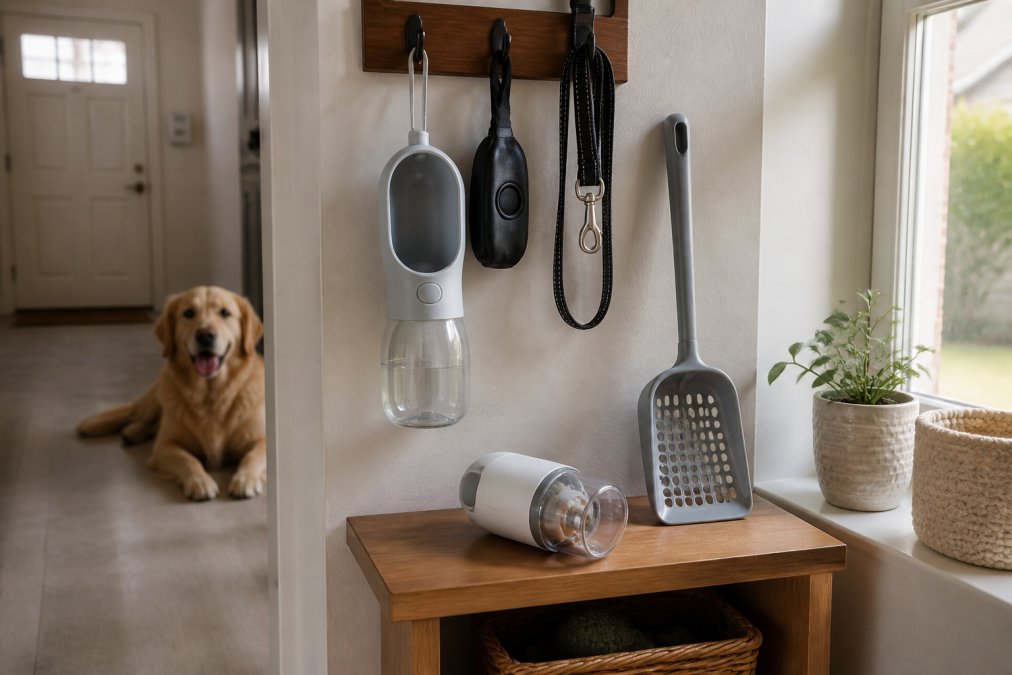
A tidy pet care station in a home hallway with a hanging 2-in-1 dog water bottle and poo scoop, a long-handled cat litter scoop, and a small pet treat launcher arranged on a shelf beside a lead hook, soft morning light from a side window
What most guides miss is that the station should hold only what you use daily. Weekly and monthly items belong in a cupboard, or the station becomes a dumping ground within a fortnight.
A workable setup looks like this:
- Lead, harness and spare bags on a hook at waist height
- Food and a scoop in a sealed container beside the bowls
- Medication and first-aid items in one labelled box
- A lidded waste bin within arm's reach of the door
Setup typically takes twenty minutes and one trip to a hardware shop. The return is a routine where leaving the house takes seconds rather than minutes.
Step 3: Choose Tools That Cut Daily Pet Care Time
The right tools remove handling steps, not just clutter. A good rule: if a tool makes you touch the same object twice, it isn't saving you anything.
Walking and Feeding Tools
The biggest time sink on a walk is stopping to deal with water and waste separately. A 2-in-1 dog water bottle with a built-in poo scoop handles both in one item, so you carry one thing instead of three. It's leak-proof, hangs from a bag or hand, and costs £12.99. For owners who want the walk to double as exercise for the dog, a Ball Launcher lets you keep the game going without throwing until your arm aches.


Feeding is simpler still. Batch-portion dry food into containers once a week and the daily job becomes tipping one container into a bowl.
Litter and Clean-Up Tools
For cat owners, the daily litter task is where minutes quietly disappear. Our Cat Litter Box Scoop lifts clumps in one pass and keeps your hand well clear of the tray, which means no gloves to buy and no second trip for cleaning gear.
Step 4: Try Alternatives to Expensive Automatic Litter Boxes
Alternatives to expensive automatic litter boxes are simpler than the marketing suggests: a good manual scoop, a lidded tray, and a fixed daily slot. Together they cost a fraction of a machine and never jam, lose power or need firmware updates.
2-in-1 Dog Water Bottle with Poop Scoop →
Automatic boxes do genuinely help some households. But they still require daily waste removal, regular litter top-ups and periodic deep cleaning, so the time saving is smaller than the price tag implies. Owners with three cats and a packed schedule often find a manual system more reliable, because there's nothing to break at 6am.
A practical alternative setup:
- One deep lidded tray per cat, plus one spare
- A long-handled scoop stored on the tray itself
- A fixed two-minute slot morning and evening
- A monthly deep clean with hot water and pet-safe cleaner
If you do buy a machine later, you'll already have the routine it depends on.
Step 5: Learn How to Keep a House Clean with Pets
Knowing how to keep a house clean with pets comes down to controlling where mess lands, not cleaning harder. Most pet mess is preventable at the source: muddy paws at the door, hair on the sofa, food scattered around the bowl.
Start with barriers. A microfibre mat inside the back door catches most of the mud before it reaches carpet. A washable throw over the dog's usual spot on the sofa saves a full upholstery clean. A tray with a raised lip under the bowls stops food and water spreading across the floor.
Then set a short daily reset, ten minutes at most: sweep the kitchen floor, shake the door mat, wipe the bowl area. Weekly, wash bedding and throws and vacuum under furniture. Monthly, deep clean bowls, trays and beds.
The difference between a house that feels clean and one that doesn't is usually the daily ten minutes, not the occasional big clean.
Common Mistakes to Avoid
The most common mistake is buying tools before writing the checklist. Without a list, you can't tell which purchase removes a step and which just adds an object to store.
Three others worth naming:
- Storing daily items in more than one place. If the lead lives in the hall and the bags live in the kitchen, every walk starts with a search.
- Skipping the daily reset. Ten minutes a day beats three hours on a Saturday, and it keeps the house presentable for guests without warning.
- Buying for the worst case rather than the common one.
Daily pet care rarely collapses because the tasks are hard. It collapses because the tools and the system don't match the routine. Cooperrite.com curates practical pet care gadgets built to remove steps rather than add them, from the 2-in-1 walking bottle with its built-in scoop to the long-handled litter scoop and the treat launcher that keeps a dog occupied while you get five minutes back. Start with the checklist, set up one station, and add the tools that earn their place. Get started with Cooperrite.com and build a pet care routine that runs itself.
Frequently Asked Questions
How can I make my daily pet care routine more efficient?
Group tasks by time of day so you are not running around. Morning: feed, fresh water, quick walk or litter scoop. Evening: another walk or play session, top up water, tidy pet areas. Keep tools in one station so nothing goes missing. A 2-in-1 dog water bottle with poo scoop means one item covers hydration and clean-up on walks, cutting down what you carry.
What are the essential daily tasks for pet owners?
Every pet needs fresh water, appropriate food, toilet breaks or litter cleaning, and some form of exercise or play. Cats also need their litter tray scooped daily. Dogs need at least one walk. Beyond that, a quick check of eyes, ears, coat and paws helps you spot problems early. An essential pet care checklist keeps these tasks visible so nothing slips on busy days.
Are there smart gadgets that help with daily pet care?
Yes. A Ball Launcher lets your dog exercise while you get on with other things, and a Pet Treat Launcher rewards good behaviour without you throwing treats by hand. For cats, Our Cat Litter Box Scoop keeps you away from mess and saves money on gloves. These tools work best when they replace a task you already do, not add a new one.
How do I manage pet care with a full-time job?
Front-load the morning: feed, water, toilet break and a short walk or play session before you leave. If you are out all day, a dog walker or a lunchtime visit helps. In the evening, combine exercise with chores by taking your dog out while listening to a podcast. Batch weekly tasks like bedding washing and supply restocking into one slot at the weekend.


