
Table of Contents
- Start by Clearing Everything Off the Counters
- Tiny Kitchen Space Saving Hacks That Actually Work
- How to Store Kitchen Appliances in Small Kitchens
- Minimalist Kitchen Counter Essentials: What Stays Out
- Build a Daily Reset Routine That Keeps Counters Clear
- Common Mistakes That Undo Your Decluttering
- Conclusion
- Frequently Asked Questions
Last Updated: September 17, 2026
Start by Clearing Everything Off the Counters
The fastest way to learn how to declutter tiny kitchen counters is to take everything off them at once. Empty worktops show you exactly how much space you have to work with.
Most people are shocked by what they find. Three wooden spoons. Two half-used bottles of oil. A bread bin that has not held bread since 2023.
Here is how to do it properly:
- Clear every item onto the floor or a table
- Wipe down the whole surface
- Sort items into three piles: keep, relocate, bin
- Put back only what you use daily
Busy homes collect clutter because nothing has a home. An empty worktop is the cleanest starting point you will get.
Tiny Kitchen Space Saving Hacks That Actually Work
Small kitchens force clever choices. The best tiny kitchen space saving hacks use space you already own but never think about.
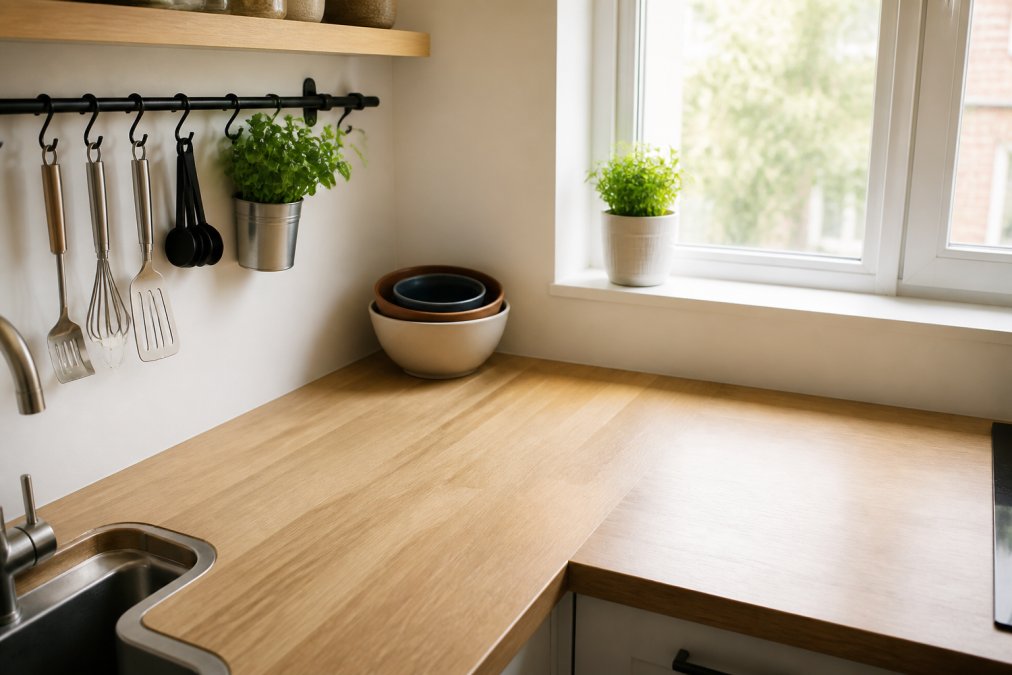
Use the Walls, the Sides and the Gaps
Walls are free storage that most people ignore. A simple rail above the worktop holds utensils, mugs or small pans.
Look at the gaps too:
- The slim space beside the fridge fits a pull-out trolley
- The inside of cupboard doors holds spice racks or hooks
- The side of a cabinet takes stick-on hooks for cloths
None of these cost much. All of them free up the worktop.
Swap Bulky Tools for Compact Ones
Bulky gadgets eat counter space fast. A full-size blender, a kettle and a toaster can cover most of a small worktop.
Compact swaps help here. A handheld sealer replaces bulky clips and bags. A measuring spoon with a built-in scale removes a separate set of scales. Each swap gives back a few centimetres.
How to Store Kitchen Appliances in Small Kitchens
Knowing how to store kitchen appliances in small kitchens comes down to one question: does this earn a permanent spot? If it does not, it goes in a cupboard.
Which? guidance on buying kitchen appliances
Which Appliances Earn a Permanent Spot
Only daily-use items should stay out. Everything else can live in a cupboard, on a shelf or in a trolley.
Ask three questions:
- Do I use this every single day?
- Does it save me real time?
- Could I reach it easily if it moved?
If the answer to the first question is no, relocate it.
A common mistake is keeping a gadget out because it was expensive. Cost does not earn counter space. Use does.
The Mini Heat Sealer from Cooperrite.com is a good example of a small tool that stays out. It takes up less room than a mug and seals bags airtight.

Minimalist Kitchen Counter Essentials: What Stays Out
Minimalist kitchen counter essentials are the handful of items you touch every day. Everything else is clutter in waiting.
360° Rotating Kitchen Tap Extender →
A workable shortlist looks like this:
- Kettle or coffee maker
- One chopping board
- Salt, pepper and oil
- A knife block or magnetic strip
- One small tool you use daily
That is it. Five or six items maximum.
The test is simple. If you have not touched it in a week, it does not belong on the worktop. Move it to a cupboard and see if you miss it. Most people never do.
NHS advice on keeping kitchens clean and safe
Build a Daily Reset Routine That Keeps Counters Clear
A five-minute reset each evening keeps counters clear without a big clean. This is the step most people skip, and it is why clutter returns.
Try this routine:
- Put every item back in its home
- Wipe the surface down
- Check for new clutter before bed
- Repeat the same order every night
The routine works because it is short. A five-minute job is easy to start. A thirty-minute job gets put off until tomorrow.
Common Mistakes That Undo Your Decluttering
Decluttering fails for predictable reasons. Spotting these mistakes early saves you from repeating the whole job in a month.
The biggest one is buying storage before you sort. Boxes and racks fill up with things you do not need. Sort first, then buy only what solves a real gap.
Other common errors:
- Keeping duplicate tools "just in case"
- Storing items you use daily out of reach
- Buying gadgets that add clutter instead of removing it
- Skipping the daily reset
- Letting one flat surface become a dumping ground
The fix is simple. Sort first. Measure the space. Then buy only what fits the gap you actually have.
Conclusion
Small worktops stay clear when every item has a home and a purpose. The steps above work because they start with an empty surface and end with a short daily habit.
Cooperrite.com stocks compact tools that help with exactly this job. The 360° Rotating Kitchen Tap Extender (£14.99) makes washing up easier without adding bulk. The LCD Digital Kitchen Scale Spoon (£7.99) replaces a full set of scales with one small tool. The Mini Heat Sealer (£6.99) keeps food fresh and takes up almost no room.

Get started with Cooperrite.com and give your worktop the space it deserves.
Frequently Asked Questions
What should I keep on my kitchen counter?
Aim for no more than three or four items that you use every single day: a kettle, a small chopping board, one knife block or magnetic strip, and perhaps a single jar for cooking utensils. Everything else, including toasters, blenders and spice racks, goes into a cupboard or onto a shelf. The test is simple: if you have not touched it in the last 48 hours, it does not belong on the worktop. This keeps the surface clear enough to actually cook on.
How do I organise a kitchen with no pantry space?
Use vertical space and the backs of doors instead. A slim pull-out rack beside the fridge holds tins and jars, over-door racks take foil, wrap and cleaning cloths, and a stackable set of clear containers keeps dry goods visible on an open shelf. Group items by how often you use them: daily items at eye level, occasional items up high. Clear containers matter more than pretty ones because you can see what you have before buying duplicates.
What are the best space-saving hacks for a small kitchen?
Mount a rail or magnetic strip on the wall for knives, utensils and small pans. Replace a bulky electric kettle or blender with a compact version, and swap a measuring jug and scales for a single digital measuring spoon. Use the gap beside the fridge for a slim trolley, and hang mugs underneath wall cupboards rather than stacking them on the worktop. Each swap frees a few centimetres, and together they add up to a usable surface.
How do I keep a tiny kitchen counter clear every day?
Run a two-minute reset after each meal: put away anything you used, wipe the surface, and return stray items to their designated home. The key is that every object needs a fixed place, otherwise it drifts back onto the worktop. Once a week, do a five-minute sweep of the whole surface and remove anything that has crept back. A routine this short is easy to keep, which matters more than a big monthly clear-out.


