
Table of Contents
- Why Quality Kitchen Tools Matter More Than You Think
- How to Choose Kitchen Utensils That Last
- Kitchen Utensil Materials Compared
- The Best Kitchen Utensils Do the Boring Jobs Well
- Kitchen Tools Worth Investing In (And What to Skip)
- Common Mistakes When Buying Kitchen Tools
- Conclusion
- Frequently Asked Questions
Last Updated: October 7, 2026
Why Quality Kitchen Tools Matter More Than You Think
A kitchen drawer full of cheap utensils costs more over five years than one set of good ones. That is the uncomfortable maths behind why quality kitchen tools matter: the £3 spatula that melts, the whisk that sheds wires, the peeler that blunts after a month. Each replacement feels trivial. Together they add up to more money, more waste and more frustration than buying properly once.
At Cooperrite, we curate household and kitchen gadgets for people who want their daily routines to run without friction. This guide covers what actually separates a tool that lasts from one that ends up in the bin, how to judge materials before you buy, and which items deserve your money.
The core argument is simple. Quality kitchen tools are not a luxury purchase. They are the cheaper option, just paid for differently.
How to Choose Kitchen Utensils That Last
Choosing kitchen utensils that last comes down to four checks you can run in under a minute, before you hand over any money. Most buyers skip all four and rely on price as a proxy for quality. Price tells you almost nothing.
Four Checks Before You Buy
- Check the join, not the handle. On any tool with two parts, look at where they meet. A spatula head glued to a stick will fail. A single-piece moulded tool, or one fixed with a visible rivet or screw, will not.
- Flex the working end. Press the blade of a peeler or the head of a spatula against your palm. If it bends easily, it will deform the first time you scrape a hot pan. Good tools flex slightly, then spring back.
- Read the heat rating. Silicone utensils should state a maximum temperature. If the packaging does not say, assume it cannot take a hot pan.
- Weigh it in your hand. A tool that feels hollow and light usually is. Weight is not a perfect signal, but a utensil with no substance behind it will not survive daily use.
Kitchen Utensil Materials Compared
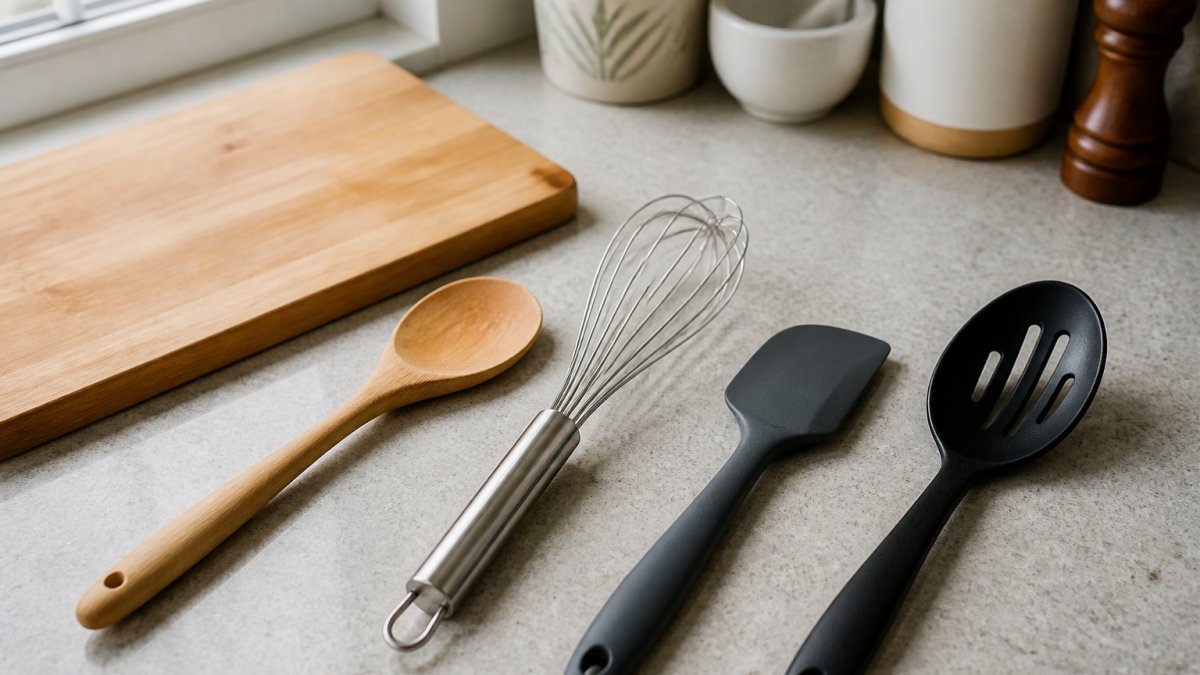
Kitchen utensil materials fall into four main families, and each has a job it does well and a job it does badly. Matching material to task matters more than buying the most expensive option on the shelf.
| Material | Best For | Avoid For | Watch Out For |
|---|---|---|---|
| Stainless steel | Whisking, chopping, draining | Non-stick pans | Heat transfer to the handle |
| Silicone | Scraping, folding, non-stick surfaces | Heavy chopping | Low-quality filler that stiffens over time |
| Wood | Stirring, serving, non-stick pans | Raw meat, dishwasher use | Cracking if left wet |
| Heat-resistant plastic | Budget sets, light use | High heat, long-term ownership | Warping and staining |
Which Material Suits Which Job
Stainless steel is the workhorse. It does not absorb flavours, it does not stain easily, and a good whisk or slotted spoon will outlast everything else in the drawer. Its weakness is heat transfer: leave a steel spoon in a simmering pot and the handle will remind you.
Silicone is the right choice for anything that touches a non-stick surface. It will not scratch the coating, and it handles high heat if the rating says so. The mistake is buying the cheapest silicone on offer. Budget silicone often contains fillers that make it stiffen and discolour within a year.
Wood remains the best material for stirring and serving. It is gentle on pans and comfortable in the hand. It is also the material most people mistreat. Wood should be hand-washed and dried, not left soaking. A wooden spoon that splits has almost always been dishwashed.
Heat-resistant plastic has one legitimate use: a low-cost starter set for a first flat. Beyond that, it warps, stains and holds onto flavours.
The Best Kitchen Utensils Do the Boring Jobs Well
The best kitchen utensils are not the ones with clever features. They are the ones that do unglamorous work, day after day, without failing. That is a harder thing to design and a harder thing to sell, which is why so much of the market is built around novelty instead.
Think about which tools you actually touch every day: the peeler, the tin opener, the spatula, the measuring jug. These get used more often than any gadget with a motor. A tin opener that slips is a daily annoyance. A measuring jug with print that washes off is worse than useless.
This is where our thinking at Cooperrite shapes what we stock. A flexible tap attachment that rotates through a full turn and cuts splashing around the sink earns its place because it solves a problem you hit three times a day. A digital measuring tool earns its place because guessing at quantities is the most common reason home cooking goes wrong. Neither is exciting. Both get used.
Kitchen Tools Worth Investing In (And What to Skip)
Kitchen tools worth investing in share one trait: they are used constantly and they fail expensively when they are cheap. Spend on the tools you touch daily. Save on the ones you use twice a year.
360-Rotation Kitchen Sink Faucet Extenders →
Worth the money:
- A good peeler, because a blunt one wastes food and time
- A sturdy tin opener, because a broken one strands the tin
- One reliable silicone spatula, because it protects non-stick surfaces
- An accurate measuring jug or digital scale, because guesswork ruins recipes
- A single-piece wooden spoon, because it costs little and lasts years
Fine to buy cheap:
- Seasonal moulds and novelty shapes
- Tools for a single technique you try once
- Extra serving spoons you rarely reach for
The pattern is straightforward. Anything with a moving part, an edge, or a measuring function deserves proper money. Anything decorative can be bought on price.
Common Mistakes When Buying Kitchen Tools
The biggest mistake when buying kitchen tools is treating a set as better value than individual pieces. A twelve-piece set for the price of two good tools means ten of those pieces are filler. You will use three of them and the rest will take up drawer space.
Other mistakes we see often:
- Buying for the drawer, not the hob. A tool that stores neatly but performs badly is still a bad tool.
- Ignoring the dishwasher question. If a tool cannot go in the dishwasher and you will not hand-wash it, do not buy it.
- Replacing instead of repairing. Many handles and heads can be re-tightened rather than replaced, which is worth checking before you bin something.
- Assuming price equals quality. A mid-priced single-piece tool usually beats a branded multi-part one.
Conclusion
The real cost of cheap kitchen tools is not the purchase price. It is the replacements, the wasted food, the scratched pans and the drawer full of things that never quite worked. Buying fewer, better tools solves all of it at once.
If you want to start somewhere, start with the tools you touch every day. Our 360-rotation kitchen sink tap extender is a good example of the principle: a simple, flexible attachment that rotates through a full turn, cuts splashing and makes washing larger pots easier. It costs £14.99, it installs in minutes, and it earns its place because you use it constantly.

Browse the Cooperrite kitchen range to find tools built to do the boring jobs well.
Frequently Asked Questions
Why does the quality of kitchen tools matter?
Quality kitchen tools matter because they change how a job feels and how long it takes. A sharp knife cuts evenly, so vegetables cook at the same rate. A sturdy pan holds heat, so food browns instead of steaming. Cheap tools often wobble, bend or blunt quickly, which means more effort for worse results. You also replace them more often, so the lower price rarely works out cheaper over a few years.
Are expensive kitchen utensils worth it?
Not automatically. Price and quality kitchen tools are not the same thing. A £14.99 tap extender that stops water splashing across the worktop can save more daily effort than a costly gadget you use twice a year. Judge each item on how often you will use it, whether it solves a real problem, and whether the build feels solid in your hand. Spend on the tools you reach for daily.
How can you tell when a kitchen utensil needs replacing?
Watch for the signs rather than the age. Wooden spoons that have split or gone grey in the grain, silicone spatulas with peeling edges, non-stick pans with scratches deep enough to catch a fingernail, and knives that will not hold an edge past a week all need replacing. Cracked or flaking surfaces can trap food and bacteria, so replace those promptly.
Are stainless steel kitchen utensils better than plastic ones?
It depends on the job. Stainless steel is durable, does not absorb smells and works well for tongs, whisks and ladles. It can scratch non-stick coatings, so use silicone, wood or plastic on those pans. Plastic is light and cheap but warps near heat and can crack over time. Many kitchens work best with a mix: steel for structure, silicone for non-stick, wood for stirring.


